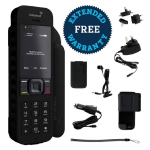
Seven years after the rapid, $6 billion collapse of its predecessor,
Bethesda-based Iridium Satellite LLC is turning a profit on its satellite
telephone service as demand for disaster-proof communications grows among
government agencies and private businesses.
The company plans to announce today a deal to provide an emergency satellite
phone network for MedStar Health, the nonprofit owner of Washington Hospital
Center and Georgetown University Hospital. The sale is one of many Iridium
Satellite has made since last year's hurricane season when, in the view of
Iridium executives, emergency responders "woke up" to the need for a
communication service that could let them talk even as cellphone networks and
landlines fail.
Iridium relays calls from its handsets across a globe-spanning network of 66
satellites. The privately held company has reported a profit for five
consecutive quarters, according to figures released by the company. For the
three months ending March 31, it reported earnings of $12.6 million, a 73
percent increase from the comparable quarter in 2005.
The company sent thousands of its phones to the Gulf Coast after Hurricane
Katrina, when satellite phone traffic surged and federal officials called for
creation of a system that would allow emergency workers to more dependably
communicate during severe crises.
"What this hurricane proved to everyone is that there are more extreme
elements out there than most people wanted to believe or were willing to
believe," said Greg Ewert, an executive vice president of Iridium
Satellite. "Most people are racing back to review disaster recovery plans,
and this marketplace has now opened up to us."
Satellite communication systems are still costly -- MedStar expects its
96-handset system to cost $300,000 to $400,000, including phones and service --
and Iridium's goal now is to focus on niche groups that need the services the
most. Emergency-response agencies are one example, Ewert said, but the
maritime, aviation and petroleum industries are also potentially important
markets.
Large marine fishing companies and operators of offshore drilling rigs are
customers that cannot risk communication breakdowns, Ewert said. Since the
hurricane season, Iridium Satellite also has had inquiries from hotel chains,
insurance companies and construction crews.
The company's competitors include California-based Globalstar Telecommunications
Ltd. Iridium Satellite's predecessor, Iridium LLC, focused on selling
individual handsets to global travelers, thinking satellite phones would be a
popular alternative to cellphone roaming fees. But the handsets were bulky and
the service was expensive.
"I think there were a lot of people who were naive about the demand,"
said Herschel Shosteck, president and chairman of the Silver Spring-based
Shosteck Group, a global communications consulting firm. "What you got was
the self-delusion of true believers who thought there was a big market for this
stuff, when actually the market is very specialized and constrained."
Iridium filed for bankruptcy in August 1999 after its 66-satellite network
failed to attract customers. Silver Spring investment firm Syncom Management
Co. and other investors bought the satellites for $25 million in late 2000 and
refashioned the company as Iridium Satellite LLC.
The reborn Iridium initially got back on track by winning a $72 million Defense
Department contract shortly after it was formed. But commercial sales have
steadily increased since its inception.
Seventy percent of its $50.9 million in first-quarter 2006 revenue was from
commercial sales, according to the company. Iridium says calls now average
about $1 a minute, less than in the early years.
The company operates as a wholesaler, selling directly only to the Pentagon.
Other sales are handled by a network of partner companies. The MedStar deal was
organized by Roadpost Inc., an international telecommunications broker.
Disaster recovery has not been the only impetus for Iridium Satellite's growth.
Ewert said the technology also is used to track shipping containers or weather
patterns.
The growth in global satellite communications is expected to continue, analysts
say. "Right now the satellite is being deemed as a sort of communication
insurance," said Patti Reali, a Pennsylvania-based research director for
Gartner Dataquest. "They're the only companies that work over the poles
and over the oceans, so they have a key market they're able to target."